What naivedyams can I offer for ŚrīRāmanavami?
(Sattvic, temple-style offerings for ŚrīRāmanavami)
A gentle guide to traditional naivedyams offered across India
ŚrīRāmanavami, the sacred appearance day of ŚrīRāma, is observed with a quiet and deeply personal sense of devotion. Unlike many other festivals that are marked by elaborate feasts and grand spreads, this day carries a different mood. The offerings are simple, cooling, and sattvic, reflecting both the early summer season and the gentle maryāda that defines ŚrīRāma. This guide brings together traditional ŚrīRāmanavami naivedyam recipes from across India, helping you choose what to offer at home.
If you are planning to prepare naivedyam at home, you may naturally wonder what dishes are appropriate. Is there a fixed menu to follow? Should you prepare a full meal or keep it minimal? What do different regions of India traditionally offer on this day?
The answer is both simple and reassuring. There is no single fixed list of dishes that must be prepared. Instead, ŚrīRāmanavami naivedyam across India follows a shared spirit rather than a rigid format.
Most homes prepare a small set of offerings that are fresh, easy to digest, and suitable for the warm season. Panakam, the traditional jaggery-based drink, is one of the most important offerings and is closely associated with the festival.
Alongside it, simple and sattvic preparations like Vadapappu (soaked lentils) or Kosambari are commonly made. Rice-based dishes form the core of many offerings, including Pulihora (tamarind rice), Mango Rice, and Curd Rice (Dadhyojanam), each bringing a balance of tangy, cooling, and grounding elements.
To make the offering more complete, many homes also include a savoury item like Medu Vada and a traditional sweet such as Appalu. Neer Mor (spiced buttermilk) is often prepared alongside Panakam, further supporting the seasonal need for cooling foods.
Fruits are always included, usually bananas and other easily available options, rounding out the naivedyam with simplicity and freshness.
In this guide, we will look at the most common naivedyams offered across different regions of India. This will help you understand the tradition and choose what feels natural and meaningful for your home.
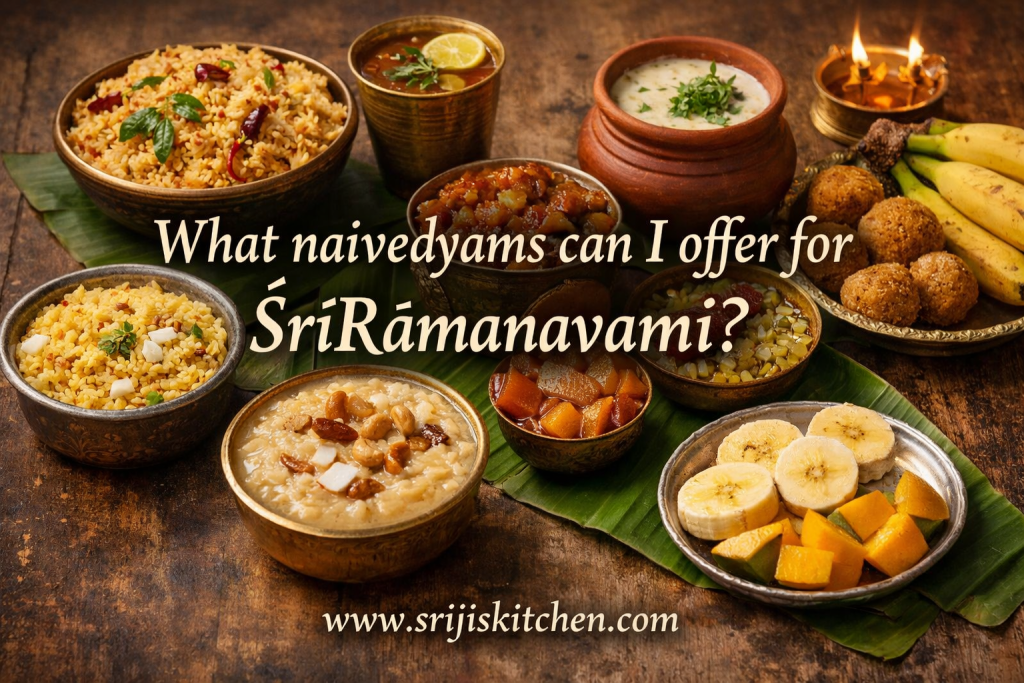
A traditional ŚrīRāmanavami naivedyam spread including pulihora, panakam, vadapappu, kosambari, and payasam.
The guiding principles of ŚrīRāmanavami naivedyam
Before looking at individual dishes, it is helpful to understand the underlying principles that shape these offerings. Across regions, the same ideas appear again and again.
First, the food is kept light and cooling. ŚrīRāmanavami falls during the warmer months in most parts of India, and the naivedyam reflects this seasonal reality. Drinks like Panakam, buttermilk preparations, and soaked lentils help balance the body and provide relief from heat.
Second, the preparations are simple and sattvic. There is minimal use of heavy spices, oil, or complex cooking methods. The focus is on clarity of taste rather than richness. This aligns with the ideal of offering food that is pure, clean, and prepared with a calm mind.
Third, the emphasis is on freshness. Many dishes are either freshly made or minimally processed. Some, like Vadapappu or Kosambari, are not cooked at all, but simply soaked and gently seasoned.
Finally, the quantity is usually modest. Even when multiple items are prepared, each one is simple. The intention is not to create a feast, but to offer what is appropriate, seasonal, and made with care.
Traditional ŚrīRāmanavami naivedyam recipes
Across India, ŚrīRāmanavami naivedyam recipes follow a shared spirit rather than a fixed menu. While the exact dishes vary from region to region, most offerings are simple, cooling, and sattvic, prepared using fresh ingredients and minimal processing.
Some of the most commonly prepared ŚrīRāmanavami naivedyam recipes include pulihora (tamarind rice), panakam (a jaggery-based cooling drink), vadapappu (soaked moong dal), kosambari (a fresh lentil salad), neer mor (spiced buttermilk), payasam (kheer), and fruits. These dishes together create a balanced offering that is light, refreshing, and suitable for the warm season in which the festival is observed.
In many homes, a combination of one rice dish, one cooling drink, one light preparation, and a simple sweet is considered sufficient. For example, pulihora with panakam and vadapappu is a widely followed combination, especially in South India. In other regions, the same principle appears through different dishes, such as kheer and panchamrit in North India or payasam and aval preparations in Kerala.
The intention behind these recipes is not variety or richness, but balance and simplicity. Each dish is chosen to complement the others, creating an offering that is easy to prepare, easy to digest, and aligned with the sattvic nature of the day.
Ultimately, traditional ŚrīRāmanavami naivedyam recipes are less about following a strict list and more about preparing what is clean, seasonal, and meaningful for your home.
South India: the classical ŚrīRāmanavami set
In many South Indian homes, especially in Andhra Pradesh, Telangana, Karnataka, and Tamil Nadu, a well-recognised set of offerings is prepared on ŚrīRāmanavami. This combination has become almost synonymous with the festival.
Pulihora, a tangy tamarind rice, is often the main offering. It is stable, travel-friendly, and widely used as prasadam in temples. Its balanced taste makes it suitable as a central dish without being heavy. Alongside this, mango rice (mamidikaya pulihora) is also commonly prepared during this season, bringing in a fresh, tangy variation using raw mango.
Vadapappu or Vada Paruppu is prepared using soaked split moong dal. This dish is light, fresh, and minimally processed, representing simplicity in its purest form. In Karnataka, a similar preparation called Kosambari is common, often enhanced with cucumber and coconut.
Curd rice, traditionally known as dadhyojanam, is another important addition in many homes. Its cooling nature makes it especially appropriate for the season, and it balances the tangy and spiced dishes in the offering.
Medu vada is often included to add a savoury, festive element to the spread. Crisp on the outside and soft within, it pairs naturally with the rest of the offerings and makes the naivedyam feel more complete for a special occasion.
Panakam, a jaggery-based drink flavoured with dry ginger and mild spices, is one of the most important offerings. It is specifically associated with ŚrīRāmanavami and is valued for its cooling properties. Neer Mor or Majjige, a diluted buttermilk drink, is often prepared alongside it, further reinforcing the seasonal balance.
A traditional sweet like appalu is also prepared in many homes, especially in Andhra and Telangana. Including a simple homemade sweet adds a sense of completeness to the offering.
Fruits are always included, usually bananas and other easily available options.
This combination works beautifully because it brings together grounding, cooling, savoury, and lightly sweet elements in a single offering. It is also highly adaptable, allowing you to prepare as many or as few items as you prefer.
Kerala: gentle sweetness and coconut-based offerings
In Kerala, the approach to ŚrīRāmanavami naivedyam is slightly different in tone, but rooted in the same principles. The dishes tend to be softer, mildly sweet, and often incorporate coconut.
Payasam is one of the most common offerings. It may be prepared with rice, lentils, or vermicelli, and is often sweetened with jaggery and enriched with coconut milk. The result is a gentle, comforting dish that is both nourishing and easy to digest.
Aval, or beaten rice, is another popular offering. It can be prepared in simple ways with jaggery and coconut, keeping the preparation light and sattvic.
Bananas and other fruits are almost always part of the offering, reinforcing the idea that simplicity and natural ingredients are central to the observance.
Maharashtra and Gujarat: seasonal drinks and festive sweets
In Western India, ŚrīRāmanavami naivedyam often reflects both the festive mood and the seasonal context.
In Maharashtra, Panha, a refreshing drink made from raw mango, is a common offering. Its tangy and cooling nature makes it ideal for the early summer heat. Shrikhand, a sweetened yoghurt preparation, is also widely prepared and offered.
In Gujarat, dishes like Lapsi, made from broken wheat and jaggery, are common. Panchamrit, a simple mixture of milk, curd, honey, sugar, and ghee, is also frequently offered.
In some homes, especially those observing fasting traditions, lighter vrat-friendly dishes are included. These may vary widely depending on local customs and family practices.
North India: simplicity and fasting traditions
In many parts of North India, ŚrīRāmanavami is observed with fasting for part or all of the day. As a result, the naivedyam tends to be simple and focused.
Kheer, a rice-based milk pudding, is one of the most common offerings. It is easy to prepare and widely accepted as a sattvic sweet.
Panchamrit is often prepared and offered, especially in temple settings. Fruits form an essential part of the offering, both as naivedyam and as part of the fasting diet.
In households observing vrat, dishes like Sabudana khichdi or other fasting-friendly preparations may be included, depending on the family tradition.
East India: light, sweet, and symbolic
In regions such as West Bengal, the offerings are typically simple, sweet, and centred around staple ingredients like rice and milk.
Payesh, the Bengali version of rice kheer, is a common preparation. Fruits and coconut-based items are also frequently offered.
The emphasis here is not on variety, but on maintaining a clean, sattvic offering that aligns with the spirit of the day.
Kashmir and other regions: minimal and pure offerings
In some traditions, including Kashmiri households, the offerings are intentionally minimal.
Plain rice, dry fruits, and simple sattvic preparations are common. These offerings highlight the idea that devotion does not depend on complexity or variety. Even the simplest food, when prepared with sincerity, is considered appropriate.
How to choose your ŚrīRāmanavami naivedyam at home
After looking at all these regional variations, it becomes clear that there is no need to feel pressured to prepare an elaborate spread. The diversity of traditions shows that what matters is not the exact dish, but the intention behind it.
If you would like a balanced and traditional set, you can choose a combination like this:
- One rice dish, such as Pulihora
- One cooling drink, such as Panakam or buttermilk
- One light preparation, such as Vadapappu or Kosambari
- One sweet, such as Payasam or Pongal
- Fresh fruits
This creates a complete and harmonious offering without being overwhelming.
If time or circumstances are limited, you can simplify even further. A small glass of Panakam, a fruit, and a simple sweet are more than sufficient. Many homes follow exactly this approach.
It is also perfectly valid to follow your family tradition, whatever it may be. If Pulihora is what you have always prepared, that itself becomes your offering. If your home follows a fasting-based observance, that too is entirely appropriate.
In many homes, including ours, pulihora is often prepared as the main offering, with panakam and vadapappu alongside.
A gentle closing thought
ŚrīRāmanavami naivedyam is not about abundance, display, or perfection. It is about offering what is pure, seasonal, and prepared with care. The diversity of practices across India shows that there is no single correct way to observe the day.
Whether you prepare a full set with Pulihora, Panakam, and Vadapappu, or offer a simple bowl of fruit and a small sweet, the essence remains the same. Each home brings its own tradition, and that itself becomes a meaningful expression of devotion.
In the end, what matters most is the quiet intention with which the offering is made.
Frequently asked questions
What is traditionally offered for ŚrīRāmanavami?
Simple sattvic foods such as panakam, vadapappu, pulihora, kosambari, payasam, and fruits are commonly offered.
Is it necessary to prepare many dishes?
No. Even a simple offering like panakam and fruits is considered appropriate.
Can I offer only one dish?
Yes. Devotion matters more than variety.