Jammu and Kashmir Sattvic Thalis
(No Onion, No Garlic)
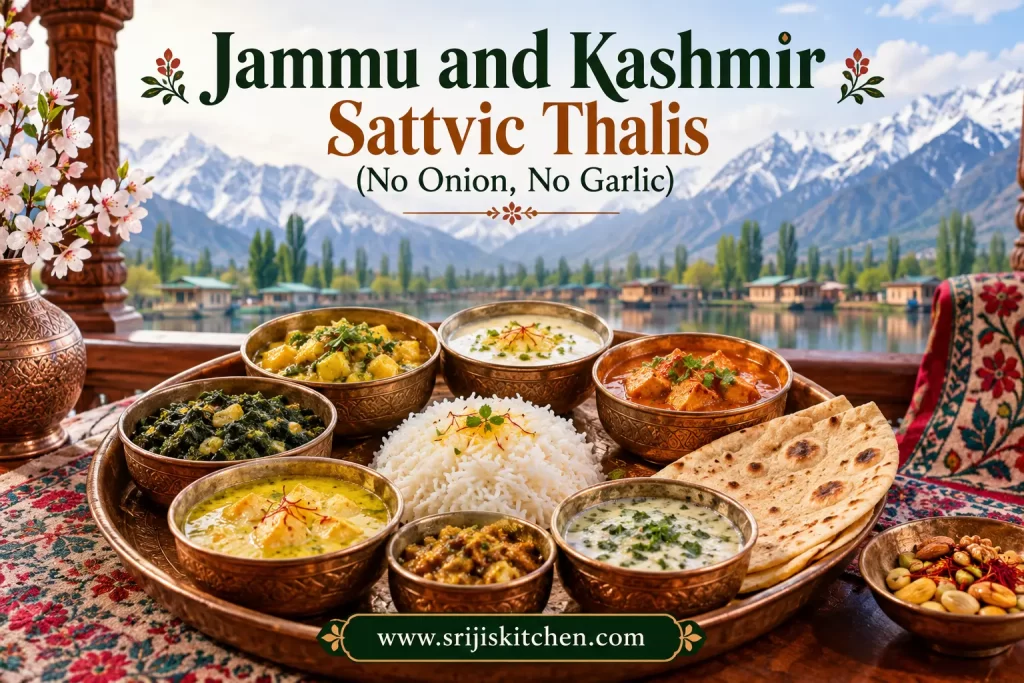
(Explore traditional Jammu and Kashmir sattvic thalis featuring distinctive regional meal combinations, prepared without onion or garlic and suitable for offering as naivedyam.)
Jammu and Kashmir has a remarkably rich culinary tradition, shaped by its varied landscapes, climate, agricultural heritage and the distinctive food traditions of its different regions and communities. Traditional meals are centred around rice and wheat, accompanied by preparations using pulses, vegetables, leafy greens, curd, paneer, spices, nuts and a wide variety of regional accompaniments.
The Jammu and Kashmir sattvic thalis in this collection celebrate these regional meal combinations while following sattvic cooking principles. Every thali is prepared without onion or garlic and is designed to be suitable for offering as naivedyam before being served as prasādam.
Jammu and Kashmir cuisine cannot be represented by a single thali. Dogra cuisine and the food traditions of the Jammu region, Kashmiri Pandit cuisine, the broader culinary traditions of the Kashmir Valley, everyday home cooking, seasonal meals and festive food traditions all offer distinctive combinations. This collection will therefore feature multiple Jammu and Kashmir thalis, each highlighting a different aspect of the region’s culinary heritage.
Indian Sattvic Thalis · Jammu and Kashmir Recipes · No Onion No Garlic Recipes · Naivedyam
The traditional Jammu and Kashmir meal
A traditional Jammu and Kashmir meal is shaped by the distinct food traditions of the Jammu region and the Kashmir Valley, with rice and wheat forming important staples alongside pulses, vegetables, leafy greens, curd and other regional preparations. Rice has a particularly important place in Kashmiri meals, while wheat-based breads and other grain preparations are prominent in many parts of the Jammu region. The combination on the plate varies considerably according to region, community, season, household and occasion.
Vegetable and pulse preparations add considerable variety to everyday meals. Lotus stem, turnip, leafy greens, potatoes, pumpkin and other locally used vegetables feature in different regional traditions, while rajma and other pulses are especially important in parts of the Jammu region. Curd-based preparations, paneer dishes, rice preparations, breads, pickles, chutneys and other traditional accompaniments may complete the meal.
There is no single fixed combination that defines every Jammu and Kashmir thali. An everyday family meal may be relatively simple, while Dogra festive meals, Kashmiri Pandit food traditions and other regional or celebratory meals can include a wider selection of rice dishes, breads, pulse preparations, vegetable dishes, sweets and accompaniments. The region’s strong geographical and community-based culinary diversity is one of the reasons we will explore its cuisine through several different thalis rather than presenting one meal as definitive.
Rice Recipes · Rajma Recipes · Vegetable Recipes · Paneer Recipes · Curd Recipes · Bread Recipes · Chutney Recipes · Sweet Recipes
Regional diversity of Jammu and Kashmir thalis
Jammu and Kashmir’s food traditions vary considerably across the region, shaped by differences in geography, climate, agriculture, locally available grains, vegetables and pulses, as well as long-established regional and community cooking traditions. The food traditions of the Jammu plains and hills differ noticeably from those of the Kashmir Valley, while Dogra and Kashmiri Pandit culinary traditions contribute distinctive dishes and meal combinations of their own.
The thalis in this collection will therefore explore Jammu and Kashmir’s regional traditions individually, with each meal prepared without onion or garlic and suitable for offering as naivedyam.
Dogra thalis
Dogra cuisine is an important culinary tradition of the Jammu region, shaped by local agriculture, seasonal produce and long-established household and festive cooking practices. Rice, wheat, pulses, curd and vegetables feature in different combinations, while dishes based on rajma, ambal-style sweet-and-sour preparations and other regional specialities give Dogra meals their distinctive character.
The Dogra thalis in this collection will explore traditional vegetarian meal combinations adapted to our no-onion, no-garlic sattvic framework.
Dogra Thalis · Dogra Recipes · Jammu Recipes · Rajma Recipes
Kashmiri Pandit thalis
Kashmiri Pandit cuisine has a distinctive culinary identity within the food traditions of the Kashmir Valley. Rice forms an important foundation of the meal, accompanied by preparations using vegetables such as lotus stem, turnip and leafy greens, together with curd, paneer and characteristic Kashmiri spices and seasonings.
The Kashmiri Pandit thalis in this collection will focus on suitable traditional vegetarian dishes, bringing them together into complete meals prepared without onion or garlic and suitable for our sattvic approach.
Kashmiri Pandit Thalis · Kashmiri Pandit Recipes · Kashmiri Vegetarian Recipes
Kashmir Valley vegetarian thalis
The Kashmir Valley has a rich food culture shaped by its mountain climate, seasonal produce and distinctive use of spices and locally available ingredients. Rice is central to many meals, while lotus stem, turnip, potatoes, leafy greens, paneer, curd and other ingredients appear in a variety of traditional preparations.
These thalis will explore suitable vegetarian dishes from the broader culinary traditions of the Kashmir Valley, carefully adapted where necessary to remain within our no-onion, no-garlic sattvic framework.
Kashmir Valley Thalis · Kashmiri Recipes · Kashmiri Vegetarian Recipes · Kashmiri Vegetable Recipes
Jammu regional thalis
Beyond specifically Dogra meal traditions, the wider Jammu region encompasses varied food traditions shaped by its plains, foothills and mountainous areas. Wheat, rice, pulses, curd, vegetables and seasonal ingredients are used in different combinations, with considerable variation between localities and communities.
The Jammu regional thalis in this collection will explore suitable traditional vegetarian meal combinations from different parts of the region while preserving their regional character within our sattvic framework.
Jammu Thalis · Jammu Recipes · Jammu Vegetarian Recipes · Jammu and Kashmir Recipes
Explore Dogra Thalis, Kashmiri Pandit Thalis, Kashmir Valley Vegetarian Thalis, and Jammu Regional Thalis to discover how traditional meal combinations vary across Jammu and Kashmir.
Jammu and Kashmir sattvic thali collection
The best way to experience Jammu and Kashmir cuisine is through complete meal combinations in which individual dishes are chosen to complement one another. This collection brings together Jammu and Kashmir sattvic thalis inspired by traditional home cooking, distinctive regional food traditions, seasonal ingredients and festive meals.
Each thali has its own page showing the complete meal and the dishes that make it distinctive. Individual dishes will also link to their own recipes, making it easy to prepare the complete thali or choose a few recipes to create a simpler Jammu and Kashmir meal at home.
As the collection develops, you will find everyday Jammu and Kashmir meals, regional thalis and more elaborate festive combinations.
Everyday Jammu and Kashmir sattvic thalis
These thalis are inspired by balanced meal combinations found in everyday home cooking across Jammu and Kashmir. They bring together rice or other suitable staples, pulses, seasonal vegetables, leafy greens, curd-based preparations and regional accompaniments in practical combinations for family meals and naivedyam.
Dogra sattvic thali
A traditional Jammu-region meal inspired by Dogra food traditions, bringing together rice or suitable breads, pulses, seasonal vegetables, curd-based dishes and characteristic regional accompaniments.
Kashmiri Pandit sattvic thali
A traditional vegetarian Kashmiri Pandit meal featuring rice, vegetable preparations, curd-based dishes and characteristic Kashmiri spices and accompaniments.
Kashmir Valley sattvic thali
A vegetarian Kashmir Valley meal centred on rice with suitable lotus stem, greens and other seasonal vegetable preparations, together with traditional regional accompaniments.
Jammu sattvic thali
A regional Jammu meal bringing together suitable rice or wheat preparations, pulses, seasonal vegetables, curd-based dishes and traditional accompaniments.
Explore our Everyday Jammu and Kashmir Thalis and individual Jammu and Kashmir Recipes to prepare complete meals or combine your favourite dishes to create your own sattvic Jammu and Kashmir meal.
Festive Jammu and Kashmir sattvic thalis
Festivals, religious observances and family celebrations often call for more elaborate Jammu and Kashmir meals. Alongside rice or wheat-based staples, pulses, vegetable preparations and curd-based dishes, festive meals may include special rice preparations, regional vegetable dishes, breads, chutneys, sweets and other traditional accompaniments chosen according to the occasion and regional or community tradition.
The festive thalis in this collection will bring these dishes together as complete sattvic meals while recognising that festive food across Jammu and Kashmir varies considerably between regions, communities, festivals and households. Rather than presenting one fixed festive thali, we will explore several traditional combinations suitable for different occasions.
Navreh Kashmiri Pandit sattvic thali
A festive Kashmiri Pandit meal inspired by Navreh traditions, bringing together rice, suitable vegetable preparations, curd-based dishes and traditional festive accompaniments.
Herath Kashmiri Pandit sattvic thali
A festive Kashmiri Pandit meal inspired by Herath traditions, featuring suitable rice and vegetable preparations, walnuts and complementary sattvic dishes.
Lohri Jammu sattvic thali
A winter festive Jammu meal inspired by Lohri traditions, bringing together suitable seasonal dishes, traditional sweets and complementary sattvic preparations.
Dogra festive sattvic thali
A festive Jammu-region meal inspired by Dogra food traditions, bringing together rice, pulses, curd-based preparations, regional vegetable dishes and traditional accompaniments.
These festive combinations provide a starting point for planning a more elaborate Jammu and Kashmir meal.
Explore Jammu and Kashmir Festival Recipes, Jammu and Kashmir Sweet Recipes, Kashmiri Pandit Recipes, and Naivedyam Recipes to add traditional dishes and accompaniments according to the occasion.
Whether you are preparing a simple everyday meal or a more elaborate festive meal, these Jammu and Kashmir sattvic thalis bring together traditional dishes in balanced combinations that can be adapted to the region, season, occasion and dishes available.
Dishes that make up a Jammu and Kashmir thali
A Jammu and Kashmir thali brings together several individual preparations, each contributing a different flavour, texture or role to the meal. Rice is an important staple, particularly in the Kashmir Valley, while wheat-based breads and other grain preparations have an important place in the food traditions of the Jammu region. Pulses, seasonal vegetables, leafy greens, curd-based dishes, paneer preparations, chutneys, pickles and traditional sweets may be served alongside according to the region, community and occasion.
Many of these dishes appear in more than one thali. Rather than repeating the same recipe, each dish in this collection has its own recipe page and can be combined with different thalis. This makes it easy to prepare a complete traditional thali or select individual dishes for a simpler everyday Jammu and Kashmir meal.
Rice, breads and traditional grain dishes
Rice forms an important part of traditional meals across Jammu and Kashmir and is especially central to the food traditions of the Kashmir Valley. Plain cooked rice may be accompanied by vegetable, pulse and curd-based preparations, while special rice dishes can form part of festive and celebratory meals.
Wheat and wheat-based breads are also important, particularly in the Jammu region, alongside other locally used grains. The relative importance of rice, breads and other grain preparations varies according to region, community and household tradition.
Explore Steamed Rice, Jammu and Kashmir Rice Recipes, Traditional Bread Recipes, and other Jammu and Kashmir Grain Recipes used across our thalis.
Rajma, dals and pulse dishes
Pulses have an important place in the food traditions of Jammu and Kashmir. Rajma is particularly associated with parts of the Jammu region, where different local varieties and preparations are traditionally eaten with rice. Dals and other pulses also provide substantial accompaniments in everyday vegetarian meals.
The choice of pulse, consistency, spices and method of preparation varies according to region and household tradition. These dishes can form the substantial centre of a simple meal or accompany a wider selection of vegetable, curd and grain preparations in a more elaborate thali.
Explore Rajma Recipes, Dal Recipes, Jammu and Kashmir Pulse Recipes, and other traditional pulse preparations to include in your Jammu and Kashmir thali.
Lotus stem, greens and vegetable dishes
Vegetable dishes bring colour, texture and seasonal variety to Jammu and Kashmir meals. Lotus stem, known as nadru in Kashmir, has an especially distinctive place in Kashmiri cooking, while turnips, potatoes and a variety of leafy greens and other seasonal vegetables appear in different regional traditions.
The vegetables used and their methods of preparation vary considerably between Jammu and the Kashmir Valley and between different communities. Kashmiri vegetarian traditions include characteristic preparations of lotus stem and greens, while the Jammu region contributes its own seasonal vegetable dishes and sweet-and-sour preparations.
Explore Lotus Stem Recipes, Kashmiri Greens Recipes, Turnip Recipes, Jammu Vegetable Recipes, and other Jammu and Kashmir Vegetable Recipes to add seasonal vegetable dishes to your thali.
Curd and paneer dishes
Curd has an important place in several food traditions of Jammu and Kashmir, both as an accompaniment and as an ingredient in cooked dishes. Curd-based gravies and preparations provide a distinctive contrast to rice, pulses and vegetables and may appear in everyday as well as more elaborate meals.
Paneer also features in vegetarian Kashmiri cooking and can be prepared with characteristic regional spices and seasonings. The particular dishes and methods vary according to community and household tradition, allowing curd and paneer preparations to add both variety and substance to a vegetarian thali.
Explore Curd Recipes, Kashmiri Paneer Recipes, and other Jammu and Kashmir Vegetarian Recipes used across our thalis.
Ambal, chutneys and accompaniments
Sweet-and-sour preparations, chutneys, pickles and other accompaniments add contrasting flavours and textures to Jammu and Kashmir meals. Ambal is particularly associated with Dogra cuisine and encompasses characteristic sweet-and-sour preparations, including versions made with pumpkin and other suitable ingredients.
Regional chutneys and pickles may be prepared from locally available fruits, vegetables, herbs and spices. These accompaniments are not necessarily present in every thali, but they provide useful contrasts to rice, breads, pulses, curd-based preparations and vegetable dishes.
Explore Ambal Recipes, Jammu and Kashmir Chutney Recipes, Pickle Recipes, and other traditional accompaniments to add regional variety to your thali.
Sweets and festive dishes
Traditional sweets add a celebratory finish to Jammu and Kashmir meals and are especially important during festivals, religious observances and family celebrations. The sweets served vary according to region, community, season and occasion, reflecting the distinct culinary traditions of Jammu and the Kashmir Valley.
A simple everyday thali does not necessarily include a sweet, while a festive meal may feature one or several special preparations. When prepared for naivedyam, these dishes can form an important part of the complete offering before the meal is served as prasādam.
Explore Jammu and Kashmir Sweet Recipes, Dogra Sweet Recipes, Kashmiri Sweet Recipes, and other Traditional Indian Sweets suitable for adding to festive Jammu and Kashmir thalis.
Browse Jammu and Kashmir Rice Recipes, Traditional Bread Recipes, Rajma Recipes, Dal Recipes, Jammu and Kashmir Vegetable Recipes, Kashmiri Paneer Recipes, Ambal Recipes, Chutney Recipes, and Jammu and Kashmir Sweet Recipes to discover the individual dishes used throughout these thalis.
Creating a sattvic Tamil Nadu thali
Traditional Tamil Nadu cuisine includes a wide range of dishes, and recipes can vary considerably between regions, communities and households. The thalis at SriJi’s Kitchen preserve the familiar structure and flavours of Tamil Nadu sāppāḍu while ensuring that the dishes are prepared without onion or garlic and are suitable for offering as naivedyam.
Rather than simply removing onion and garlic from recipes that depend on them for flavour, we select traditional ingredients, spice combinations and cooking methods that allow each dish to retain its distinctive Tamil character. Lentils, seasonal vegetables, tamarind, coconut, sesame, chillies, curry leaves and traditional spice blends provide many ways to create flavourful and satisfying sāppāḍu naturally.
A sattvic Tamil Nadu thali can be simple or elaborate. What matters is choosing dishes that complement one another and preparing them fresh with care, particularly when the sāppāḍu is intended for offering as naivedyam.
Explore Tamil Nadu Recipes and Sattvic Recipes to discover individual dishes and build your own traditional Tamil Nadu thali.
Preparing Tamil Nadu thalis for naivedyam
For devotees, preparing a traditional Tamil Nadu sāppāḍu can also be an act of devotion. Freshly prepared sādam, paruppu, sambar, kuzhambu, rasam, kootu, poriyal, keerai, sweets and other suitable dishes can be brought together as a complete thali and respectfully offered as naivedyam before being served.
The Tamil Nadu thalis at SriJi’s Kitchen are created with this purpose in mind. The recipes are prepared without onion or garlic, allowing everyday sāppāḍu as well as more elaborate festive thalis to be prepared for offering.
The number of dishes is not what makes an offering meaningful. A simple sāppāḍu of hot sādam, paruppu and a vegetable preparation can be offered with the same care and devotion as a larger festive thali.
For guidance on preparing and offering food at home, see our Naivedyam guide.
Why Tamil Nadu thalis?
Tamil Nadu has a rich and varied food tradition, with sāppāḍu combinations shaped by region, climate, local agriculture, temple traditions and family customs. A thali provides a natural way to experience this diversity because it brings several complementary dishes together as they would be enjoyed as part of a complete Tamil Nadu sāppāḍu.
Rather than presenting Tamil Nadu cuisine as a collection of isolated recipes, these thalis show how sādam, paruppu, sambar, kuzhambu, rasam, kootu, poriyal, keerai, pachadi and accompaniments work together on the same plate. They also allow us to explore the differences between everyday sāppāḍu, festive sāppāḍu and regional food traditions across Tamil Nadu.
For SriJi’s Kitchen, this format also provides a practical way to build complete sattvic thalis from individual Tamil Nadu Recipes, while keeping every preparation suitable for offering as naivedyam.
Explore our Tamil Nadu Recipes and Indian Sattvic Thalis to discover individual dishes and traditional meal combinations from Tamil Nadu and across India.
How to serve a Tamil Nadu thali
A traditional Tamil Nadu thali is generally served with sādam forming the foundation of the sāppāḍu, accompanied by preparations such as paruppu, sambar, kuzhambu, rasam, kootu, poriyal, keerai and pachadi. Appalam, pickle, curd and a sweet may also be included according to the occasion.
The dishes are enjoyed in complementary combinations rather than as completely separate courses. Hot sādam may first be eaten with paruppu and ghee, followed by sambar, kuzhambu or rasam, while kootu, poriyal, keerai, pachadi and other accompaniments are enjoyed alongside. Curd rice commonly brings the rice-based part of the sāppāḍu towards a gentle close.
For a festive or more elaborate Tamil Nadu sāppāḍu, it may traditionally be served on a banana leaf, with additional savoury and sweet preparations included according to the occasion. Regional, community and family traditions influence both the dishes served and the way the sāppāḍu is arranged.
Choose from our Tamil Nadu Recipes to assemble and serve a complete traditional Tamil Nadu thali.
Common mistakes to avoid
Treating one thali as the definitive Tamil Nadu thali: Tamil Nadu food traditions vary considerably across temple traditions, Kongunadu, Chettinad, the Kaveri delta and Thanjavur, southern Tamil Nadu, households and occasions.
Overlooking traditional grains: Rice is central to most Tamil Nadu sāppāḍu, but the state’s food heritage also includes millets and other traditional grains that remain important in particular regions and communities.
Making the thali unnecessarily elaborate: An everyday Tamil Nadu sāppāḍu can be simple. More dishes do not automatically make the thali more traditional or better balanced.
Including too many similar dishes: Choose preparations that complement one another rather than repeating the same vegetables, textures or dominant flavours across the thali.
Reducing Tamil Nadu cuisine to one regional tradition: Temple-style cooking, Kongunadu, Chettinad and other regional traditions are important parts of Tamil Nadu’s culinary heritage, but no single tradition represents the full diversity of the state’s food traditions.
Treating sattvic cooking as simply removing onion and garlic: Choose traditional ingredients, seasonings and cooking methods that produce a balanced dish that is naturally flavourful and recognisably Tamil.
Ignoring seasonal and regional combinations: Rice, lentils, vegetables, sambar, kuzhambu, rasam, kootu, poriyal, keerai and accompaniments vary according to local produce, season and regional food customs.
Treating festive and everyday sāppāḍu as the same: A festive Tamil Nadu sāppāḍu may include special preparations such as puliyodarai, sakkarai pongal, vadai, payasam and additional dishes that would not normally appear together in a simple everyday sāppāḍu.
Use our Tamil Nadu Recipes and Tamil Nadu sattvic thalis to choose dishes that complement one another naturally in a complete Tamil Nadu sāppāḍu.
Frequently asked questions about Tamil Nadu sattvic thalis
Traditional Tamil Nadu sāppāḍu varies considerably by region, community, household, season and occasion. These answers cover some common questions about Tamil Nadu thalis, Tamil Nadu sāppāḍu and preparing sattvic Tamil sāppāḍu at home.
What is a traditional Tamil Nadu thali?
A traditional Tamil Nadu thali brings together sādam with complementary preparations that may include paruppu, sambar, kuzhambu, rasam, kootu, poriyal, keerai, pachadi, curd and other accompaniments.
There is no single combination that defines every Tamil Nadu thali. The dishes served vary considerably across temple traditions, Kongunadu, Chettinad, the Kaveri delta and Thanjavur, southern Tamil Nadu and other regional food traditions, as well as according to household, season and occasion.
Are all Tamil Nadu thalis rice-based?
Rice forms the foundation of most traditional Tamil Nadu thalis and may be served as sādam with paruppu, sambar, kuzhambu, rasam, kootu, poriyal and other accompaniments.
However, Tamil Nadu’s food heritage is not limited to rice. Millets and other traditional grains have long been important in particular regions and communities and can form the basis of their own traditional sāppāḍu and preparations.
What makes these Tamil Nadu thalis sattvic?
The Tamil Nadu thalis at SriJi’s Kitchen are prepared without onion or garlic. Suitable traditional ingredients, seasonings and cooking methods are used to build flavour rather than treating sattvic cooking as simply removing these ingredients from an existing recipe.
The aim is to preserve the recognisable character of Tamil dishes while bringing them together as balanced sattvic thalis that can be prepared for everyday sāppāḍu as well as devotional and festive occasions
Are Tamil Nadu thalis suitable for naivedyam?
Yes. The Tamil Nadu thalis in this collection are designed so that the individual dishes can be prepared for naivedyam before being served as prasādam.
A naivedyam sāppāḍu does not need to contain a large number of dishes. A simple combination can form a complete offering, while festivals and special occasions may call for a more elaborate sāppāḍu with additional savouries, sweets and traditional preparations.
Is Tamil temple-style food the same as Tamil Nadu cuisine?
No. Tamil temple-style food is an important part of Tamil Nadu’s sattvic culinary heritage, with preparations shaped by the customs of particular temples, festivals and offerings.
Tamil Nadu cuisine is much broader. Kongunadu, Chettinad, the Kaveri delta and Thanjavur, southern Tamil Nadu and other regions and communities have their own characteristic ingredients, preparations and sāppāḍu combinations. This is why the collection explores several regional thalis rather than presenting one tradition as representative of the entire state.
What is the difference between an everyday and a festive Tamil Nadu thali?
An everyday Tamil Nadu thali can be relatively simple, combining sādam with a few complementary dishes such as paruppu, sambar or kuzhambu, a vegetable preparation and rasam or curd. The precise combination depends on the region, household and ingredients available.
A festive Tamil Nadu thali is generally more elaborate and may include special preparations such as puliyodarai, sakkarai pongal, vadai, payasam and additional vegetable dishes, savouries or sweets. The dishes served vary according to the festival, region, community and family tradition.
Can I create my own Tamil Nadu sattvic thali?
Yes. Begin with sādam or another suitable traditional grain preparation and choose dishes that naturally complement one another, such as paruppu, sambar or kuzhambu, a seasonal poriyal or kootu, rasam and one or two suitable accompaniments. There is no need to include every type of Tamil dish in a single sāppāḍu.
Use our individual Tamil Nadu Recipes to build different combinations according to the region, season and occasion. The same recipe may also appear in more than one thali when it naturally belongs with those sāppāḍu combinations.
What dishes are commonly included in a Tamil Nadu thali?
A Tamil Nadu thali may include sādam accompanied by dishes such as paruppu, sambar, kuzhambu, rasam, kootu, poriyal, keerai, pachadi, curd, pickle and appalam. The particular dishes and combinations vary considerably between regions, communities and households.
Everyday thalis may contain only a few dishes, while festive sāppāḍu can include special rice preparations, vadai, additional vegetable dishes, sweets such as sakkarai pongal or payasam, and other traditional accompaniments.
Do Tamil Nadu thalis vary by region?
Yes. Tamil Nadu has several distinctive regional and community food traditions. Tamil temple-style cooking, Kongunadu cooking, Chettinad cuisine, the food traditions of the Kaveri delta and Thanjavur, and those of southern Tamil Nadu can differ considerably in their ingredients, seasonings, preparations and sāppāḍu combinations.
This diversity is why our collection includes several Tamil Nadu sattvic thalis rather than presenting one combination as the definitive Tamil Nadu thali. Each thali can highlight a particular regional or culinary tradition while following the same no-onion, no-garlic sattvic approach.
These answers provide a starting point for planning traditional Tamil Nadu thalis at home. Explore the thali combinations throughout this collection or choose individual Tamil Nadu Recipes to create a Tamil Nadu sāppāḍu suited to the season, occasion and dishes available.
Final thoughts
Tamil Nadu’s food traditions offer an extraordinary range of sāppāḍu, from simple everyday rice-based sāppāḍu to regional preparations using traditional grains and elaborate festive thalis. Tamil temple traditions, Kongunadu, Chettinad, the Kaveri delta and Thanjavur, southern Tamil Nadu and other regional traditions each contribute distinctive dishes and sāppāḍu combinations to this wider culinary heritage.
Through this collection of Tamil Nadu sattvic thalis, we hope to preserve that regional diversity while presenting practical sāppāḍu combinations prepared without onion or garlic. Each thali can be explored as a complete sāppāḍu, while the individual Tamil Nadu Recipes can be combined in different ways according to the region, season and occasion.
Whether you are preparing a simple family sāppāḍu, exploring a particular regional tradition or planning a festive offering, these thalis provide a starting point for creating a balanced Tamil Nadu sāppāḍu suitable for offering as naivedyam and serving as prasādam.
Explore Indian Sattvic Thalis · Tamil Nadu Recipes · Naivedyam
Explore sattvic thalis from other Indian states and Union Territories
Continue exploring India’s regional food traditions through our collection of Indian Sattvic Thalis from states and Union Territories. Each collection brings together traditional meal combinations prepared without onion or garlic and suitable for offering as naivedyam.
Return to Indian Sattvic Thalis to browse the complete collection of regional thalis from across India.