Arunachal Pradesh Sattvic Thalis
(No Onion, No Garlic)
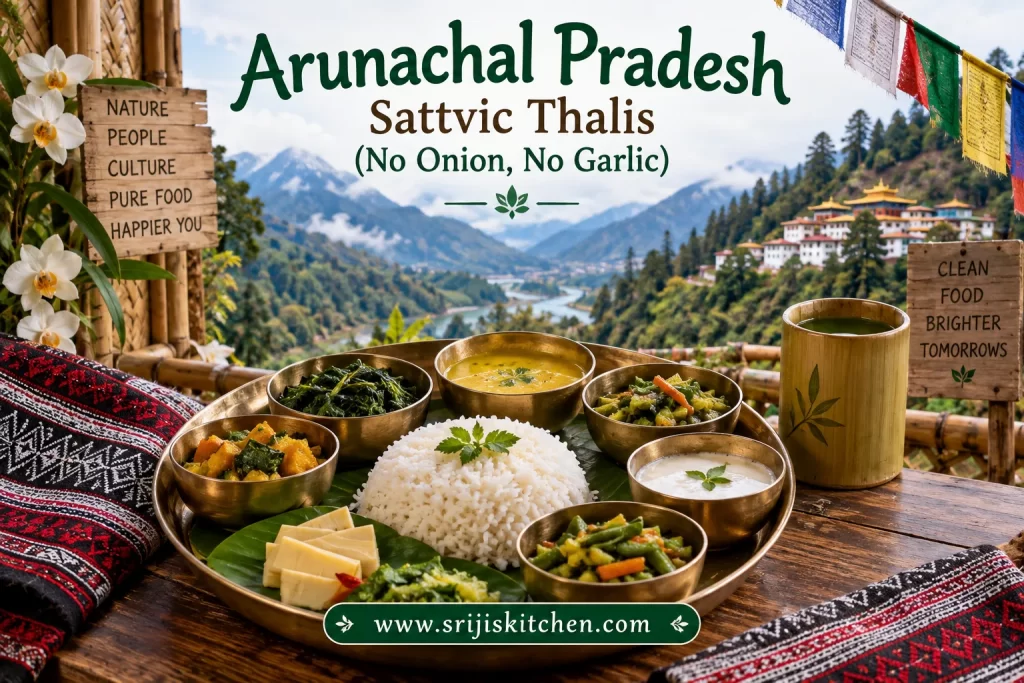
(Explore Arunachal Pradesh sattvic thalis inspired by distinctive regional and community food traditions, prepared without onion or garlic and suitable for offering as naivedyam.)
Arunachal Pradesh has a remarkably diverse culinary heritage, shaped by its mountainous landscape, local agriculture and the food traditions of its many indigenous communities. Traditional meals vary considerably across the state, with rice, millets, maize, leafy greens, locally grown vegetables, pulses, bamboo shoots and fermented foods forming important parts of different regional and community cuisines.
The Arunachal Pradesh sattvic thalis in this collection explore these regional food traditions through vegetarian meal combinations adapted to follow sattvic cooking principles. Every thali is prepared without onion or garlic and is designed to be suitable for offering as naivedyam before being served as prasādam.
Arunachal Pradesh cuisine cannot be represented by a single thali. The food traditions of communities such as the Monpa, Nyishi, Adi, Apatani, Galo and others reflect different landscapes, crops, ingredients and methods of preparation. This collection will therefore feature multiple Arunachal Pradesh thalis, each highlighting a different aspect of the state’s diverse culinary heritage while clearly distinguishing sattvic adaptations from traditional preparations where necessary.
Indian Sattvic Thalis · Arunachal Pradesh Recipes · No Onion No Garlic Recipes · Naivedyam
Traditional meals in Arunachal Pradesh
A traditional Arunachal Pradesh meal reflects the state’s considerable geographical and cultural diversity. Rice is an important staple across many communities, while millets, maize and other locally cultivated grains also have a place in particular regions. Meals may be accompanied by leafy greens, locally grown vegetables, pulses, bamboo shoots and other seasonal ingredients, with the combination varying according to community, locality, season and occasion.
Traditional cooking often makes use of relatively simple preparation methods that allow the character of the ingredients to remain prominent. Boiling, steaming and cooking vegetables and greens with locally available herbs and seasonings are found in different food traditions, while fermented ingredients also play an important role in several communities. Bamboo shoots, forest greens and locally cultivated produce contribute distinctive flavours to many regional preparations.
There is no single fixed combination that defines every Arunachal Pradesh thali. The food traditions of communities such as the Monpa, Nyishi, Adi, Apatani and Galo have developed within different landscapes and cultural settings, resulting in considerable variation in ingredients and preparations. Our sattvic thalis therefore draw from these diverse traditions while using vegetarian ingredients and excluding onion and garlic, with adaptations identified where a traditional preparation is not inherently sattvic.
Rice Recipes · Millet Recipes · Vegetable Recipes · Leafy Green Recipes · Bamboo Shoot Recipes · Sattvic Recipes · Sweet Recipes
Regional diversity of Arunachal Pradesh thalis
Arunachal Pradesh’s food traditions vary considerably across the state, shaped by differences in altitude, climate, agriculture, locally available grains and vegetables, and the distinct culinary traditions of its many indigenous communities. Rice is an important staple across much of the state, while millets, maize, leafy greens, bamboo shoots and other locally available ingredients also contribute to the diversity of traditional meals.
The thalis in this collection will therefore explore selected Arunachal Pradesh culinary traditions individually. Each thali will focus on suitable vegetarian preparations and carefully identified sattvic adaptations, prepared without onion or garlic and suitable for offering as naivedyam.
Monpa-inspired thalis
The Monpa communities of western Arunachal Pradesh have food traditions shaped by the high-altitude environment and the wider Himalayan cultural landscape. Rice, barley, maize, buckwheat, vegetables and leafy greens are among the ingredients encountered in the region, while boiling, steaming and fermentation feature in traditional food preparation.
The Monpa-inspired thalis in this collection will focus on suitable vegetarian dishes and grain and vegetable preparations that can be brought together within our no-onion, no-garlic sattvic framework.
Monpa-Inspired Thalis · Monpa Recipes · Arunachal Pradesh Vegetable Recipes · Himalayan Recipes
Nyishi-inspired thalis
The Nyishi are one of the major indigenous communities of Arunachal Pradesh, with traditional foodways closely connected to locally cultivated crops and available forest produce. Rice is an important staple, accompanied by vegetables, leafy greens, bamboo shoots and other seasonal ingredients in different preparations.
The Nyishi-inspired thalis in this collection will explore suitable plant-based elements of these food traditions while adapting the meal where necessary to meet our sattvic, no-onion, no-garlic requirements.
Nyishi-Inspired Thalis · Nyishi Recipes · Bamboo Shoot Recipes · Arunachal Pradesh Recipes
Adi-inspired thalis
The Adi communities of central and eastern Arunachal Pradesh have diverse food traditions based on locally cultivated and gathered ingredients. Rice occupies an important place in everyday food, while vegetables, leafy greens, bamboo shoots and other seasonal produce contribute to traditional meals.
The Adi-inspired thalis in this collection will bring together suitable vegetarian preparations while maintaining a clear distinction between documented traditional dishes and adaptations made specifically for our sattvic framework.
Adi-Inspired Thalis · Adi Recipes · Rice Recipes · Leafy Green Recipes
Apatani-inspired thalis
The Apatani food traditions of the Ziro Valley developed within a distinctive agricultural landscape renowned for wet-rice cultivation. Rice forms an important part of the traditional diet, complemented by locally grown and gathered vegetables, greens and other seasonal ingredients.
The Apatani-inspired thalis in this collection will explore vegetarian elements that can be presented within a sattvic meal, with adaptations made where necessary to exclude ingredients unsuitable for naivedyam.
Apatani-Inspired Thalis · Apatani Recipes · Ziro Valley Recipes · Rice Recipes
Galo-inspired thalis
The Galo communities have their own distinctive food traditions shaped by local agriculture and the ingredients available in their part of Arunachal Pradesh. Rice is an important staple, while vegetables, leafy greens, bamboo shoots and other locally available plant foods contribute to everyday meals.
The Galo-inspired thalis in this collection will focus on suitable vegetarian preparations and sattvic adaptations, bringing together regional ingredients without onion or garlic while preserving as much of their traditional character as possible.
Galo-Inspired Thalis · Galo Recipes · Arunachal Pradesh Recipes · Vegetable Recipes
Explore Monpa-Inspired Thalis, Nyishi-Inspired Thalis, Adi-Inspired Thalis, Apatani-Inspired Thalis, and Galo-Inspired Thalis to discover how the food traditions of Arunachal Pradesh vary across its communities and landscapes.
Arunachal Pradesh sattvic thali collection
The best way to explore the diverse food traditions of Arunachal Pradesh is through complete meal combinations in which grains, vegetables, leafy greens and other locally characteristic ingredients are brought together. This collection presents Arunachal Pradesh sattvic thalis inspired by traditional home cooking, community food traditions, local agriculture and seasonal ingredients from different parts of the state.
Each thali has its own page showing the complete meal and the dishes that make it distinctive. Individual dishes will also link to their own recipes, making it easy to prepare the complete thali or choose a few recipes to create a simpler Arunachal Pradesh-inspired sattvic meal at home.
As the collection develops, you will find simple everyday meal combinations alongside thalis inspired by the food traditions of different Arunachal Pradesh communities. Where a traditional preparation requires adaptation to meet our sattvic requirements, this will be clearly identified rather than presenting the adapted dish as an unchanged traditional recipe.
Everyday Arunachal Pradesh sattvic thalis
These thalis are inspired by the simpler grain-and-vegetable combinations found across the food traditions of Arunachal Pradesh. They bring together rice or other locally used grains with seasonal vegetables, leafy greens, pulses, bamboo shoots and suitable accompaniments in practical combinations prepared without onion or garlic for family meals and naivedyam.
Monpa-inspired sattvic thali
A sattvic meal inspired by Monpa food traditions, bringing together locally characteristic grains, vegetables and leafy greens in a no-onion, no-garlic combination.
Nyishi-inspired sattvic thali
A sattvic meal inspired by Nyishi food traditions, combining rice, seasonal vegetables, leafy greens and suitable regional ingredients without onion or garlic.
Adi-inspired sattvic thali
A sattvic meal inspired by Adi food traditions, centred on rice with vegetables, leafy greens and other locally characteristic plant-based preparations.
Apatani-inspired sattvic thali
A sattvic meal inspired by the food traditions of the Ziro Valley, bringing together rice, seasonal vegetables and greens in a no-onion, no-garlic combination.
Galo-inspired sattvic thali
A sattvic meal inspired by Galo food traditions, combining rice, vegetables, leafy greens and suitable locally characteristic ingredients for a balanced meal.
Explore our Everyday Arunachal Pradesh Thalis and individual Arunachal Pradesh Recipes to prepare complete meals or combine your favourite dishes to create your own sattvic Arunachal Pradesh meal.
Festive Arunachal Pradesh sattvic thalis
Festivals, community celebrations and family occasions in Arunachal Pradesh can involve more elaborate meals than those prepared for everyday eating. The foods served vary considerably between communities and occasions, reflecting differences in local crops, seasonal produce and established culinary traditions. Rice and other grains may be accompanied by a wider selection of vegetables, leafy greens, bamboo shoot preparations and other locally characteristic dishes.
The festive thalis in this collection will draw inspiration from these diverse food traditions while remaining specifically sattvic. Rather than presenting a single festive meal as representative of the entire state, we will explore carefully selected vegetarian combinations inspired by particular community and regional food traditions, prepared without onion or garlic and suitable for offering as naivedyam.
Monpa-inspired festive sattvic thali
A festive sattvic meal inspired by Monpa food traditions, bringing together suitable grains, vegetables and leafy greens in a no-onion, no-garlic combination.
Nyishi-inspired festive sattvic thali
A festive sattvic meal inspired by Nyishi food traditions, combining rice, seasonal vegetables, leafy greens and suitable regional ingredients.
Adi-inspired festive sattvic thali
A festive sattvic meal inspired by Adi food traditions, centred on rice with vegetables, greens and other suitable plant-based preparations.
Apatani-inspired festive sattvic thali
A festive sattvic meal inspired by the food traditions of the Ziro Valley, combining rice, seasonal vegetables and greens without onion or garlic.
These festive combinations provide a starting point for planning a more elaborate Arunachal Pradesh-inspired sattvic meal.
Explore Arunachal Pradesh Festival Recipes, Arunachal Pradesh Vegetable Recipes, Arunachal Pradesh Rice Recipes, and Naivedyam Recipes to add suitable regional dishes and accompaniments according to the occasion.
Whether you are preparing a simple everyday meal or a more elaborate festive meal, these Arunachal Pradesh sattvic thalis bring together carefully selected dishes in balanced combinations that can be adapted to the community tradition, season, occasion and ingredients available.
Dishes that make up an Arunachal Pradesh thali
An Arunachal Pradesh-inspired thali can bring together several preparations reflecting the grains, vegetables, greens and other plant foods used across the state’s diverse culinary traditions. Rice is an important staple among many communities, while maize, millets, buckwheat and other grains are also associated with particular regions and food traditions. Seasonal vegetables, leafy greens, pulses, bamboo shoots and locally available herbs can provide the accompanying dishes.
Many of these ingredients and preparations can appear in more than one thali. Rather than repeating the same recipe, each suitable dish in this collection will have its own recipe page and can be combined with different thalis. This makes it possible to explore different Arunachal Pradesh-inspired meal combinations while keeping the distinction between traditional preparations and our sattvic adaptations clear.
Rice and traditional grain dishes
Rice occupies an important place in the food traditions of many Arunachal Pradesh communities and provides the staple around which a meal can be built. The type of rice and method of preparation can vary according to locality and community, while other grains contribute additional diversity to the state’s food heritage.
Maize, millets, buckwheat and other grains are used in particular areas and communities, reflecting differences in altitude, climate and agriculture. These grains provide useful foundations for thalis inspired by different parts of Arunachal Pradesh rather than treating rice as the only traditional staple.
Explore Rice Recipes, Millet Recipes, Maize Recipes, Buckwheat Recipes, and other Arunachal Pradesh Rice and Grain Recipes used across our thalis.
Pulses and legumes
Pulses and legumes can provide suitable accompaniments within our Arunachal Pradesh sattvic thalis. Their use and methods of preparation vary between communities, and they can be combined with rice, other grains, vegetables and greens as part of different meal combinations.
Explore Arunachal Pradesh Pulse Recipes, Lentil Recipes, and other Sattvic Pulse Recipes to add suitable plant-based dishes to your thali.
Vegetables and leafy greens
Vegetables and leafy greens contribute much of the seasonal diversity found in the food traditions of Arunachal Pradesh. Cultivated vegetables are used alongside locally available greens and other plant foods, with ingredients differing considerably according to altitude, season, locality and community.
Traditional cooking often uses comparatively straightforward methods such as boiling and steaming, allowing the character of fresh ingredients to remain prominent. For our sattvic thalis, suitable vegetables and greens can be prepared without onion or garlic while retaining simple regional cooking methods wherever possible.
Explore Arunachal Pradesh Vegetable Recipes, Leafy Green Recipes, Steamed Vegetable Recipes, and other seasonal preparations to add vegetables and greens to your thali.
Bamboo shoot dishes
Bamboo shoots are an important ingredient in several culinary traditions of Arunachal Pradesh. Fresh and fermented bamboo shoots are used in different ways and contribute distinctive flavours to regional cooking, although their preparation and use vary between communities.
Within this collection, bamboo shoot dishes will be selected carefully for the sattvic framework. Where a documented vegetarian preparation is suitable, we will retain its traditional character as closely as possible. Where changes are required, the recipe will be identified as an adaptation rather than presented as an unchanged traditional dish.
Explore Bamboo Shoot Recipes and Arunachal Pradesh Vegetable Recipes to discover suitable bamboo shoot preparations used across our thalis.
Fermented and traditional accompaniments
Fermentation forms an important part of several Arunachal Pradesh food traditions, with different communities using fermented plant ingredients and other preserved foods to develop characteristic flavours. These traditions vary considerably between communities and preparations.
For our sattvic thalis, suitable plant-based fermented ingredients and accompaniments will be considered individually within our naivedyam framework. Where an ingredient or preparation requires modification, that adaptation will be clearly identified.
Explore Arunachal Pradesh Accompaniment Recipes, Bamboo Shoot Recipes, and other suitable Sattvic Accompaniments to complement the rice, grains, vegetables and greens in these thalis.
Sweets and festive preparations
Sweet preparations and special foods can add a celebratory element to meals prepared for festivals, religious observances and family occasions. The dishes associated with celebrations vary among Arunachal Pradesh’s many communities, and there is no single group of sweets that represents the entire state.
Our festive sattvic thalis will include suitable sweet or special preparations where these can be reliably connected with the relevant culinary tradition and prepared within our naivedyam framework. Adapted preparations will be identified accordingly rather than described as universally traditional Arunachal Pradesh sweets.
Explore Arunachal Pradesh Sweet Recipes, Festive Recipes, and other Traditional Indian Sweets suitable for adding to festive sattvic thalis.
Browse Arunachal Pradesh Rice Recipes, Millet Recipes, Maize Recipes, Buckwheat Recipes, Pulse Recipes, Arunachal Pradesh Vegetable Recipes, Leafy Green Recipes, Bamboo Shoot Recipes, and Arunachal Pradesh Sweet Recipes to discover the individual dishes used throughout these thalis.
Creating a sattvic Arunachal Pradesh thali
Traditional Arunachal Pradesh food encompasses the distinct culinary traditions of many communities, and ingredients and methods of preparation vary considerably across the state. The thalis at SriJi’s Kitchen draw from these traditions while ensuring that the dishes are vegetarian, prepared without onion or garlic and suitable for offering as naivedyam.
Rather than simply removing unsuitable ingredients from dishes in which they play an essential role, we focus wherever possible on traditional plant-based ingredients and simple cooking methods that can naturally fit our sattvic framework. Rice and other grains, seasonal vegetables, leafy greens, pulses, bamboo shoots, locally characteristic herbs and suitable seasonings provide a varied foundation for creating Arunachal Pradesh-inspired sattvic meals.
A sattvic Arunachal Pradesh thali can be simple or elaborate. What matters is choosing dishes that complement one another, respecting the particular community or regional tradition that inspired them, and preparing them fresh with care, particularly when the meal is intended for offering as naivedyam. Where a traditional dish has been modified substantially to meet these requirements, we identify it as a sattvic adaptation rather than presenting it as an unchanged traditional preparation.
Explore Arunachal Pradesh Recipes and Sattvic Recipes to discover individual dishes and build your own Arunachal Pradesh-inspired sattvic thali.
Preparing Arunachal Pradesh thalis for naivedyam
For devotees, preparing a meal inspired by the food traditions of Arunachal Pradesh can also be an act of devotion. Freshly prepared rice or other suitable grains, pulses, seasonal vegetables, leafy greens and other sattvic dishes can be brought together as a complete thali and respectfully offered as naivedyam before being served as prasādam.
The Arunachal Pradesh thalis at SriJi’s Kitchen are created with this purpose in mind. The recipes are vegetarian and prepared without onion or garlic, with other ingredients selected according to our naivedyam framework. This allows simple everyday meals as well as more elaborate festive combinations to be prepared for offering while drawing inspiration from the state’s diverse culinary traditions.
The number of dishes is not what makes an offering meaningful. A simple meal of freshly cooked rice, a suitable pulse preparation and a vegetable or leafy green dish can be offered with the same care and devotion as a larger festive thali.
For guidance on preparing and offering food at home, see our Naivedyam guide.
Why Arunachal Pradesh thalis?
Arunachal Pradesh thalis offer an opportunity to explore a side of Indian regional cuisine that is very different from the more familiar thali traditions of many other states. Rice and other locally used grains are paired with seasonal vegetables, leafy greens, bamboo shoots and regional ingredients, creating meals in which the natural character of the ingredients remains prominent.
Their appeal also lies in their diversity. The mountainous landscape, variations in altitude and climate, and the food traditions of communities such as the Monpa, Nyishi, Adi, Apatani and Galo have produced distinctive combinations of grains, vegetables, greens and local ingredients. Moving from one community-inspired thali to another therefore offers a different expression of Arunachal Pradesh’s culinary heritage.
For anyone interested in discovering India beyond its better-known regional cuisines, these thalis provide a fascinating starting point. Their emphasis on local produce, traditional grains, seasonal ingredients and comparatively simple cooking methods also makes them especially interesting to explore within a sattvic framework.
Explore our Arunachal Pradesh Recipes and Indian Sattvic Thalis to discover individual dishes and meal combinations inspired by Arunachal Pradesh and food traditions from across India.
How to serve an Arunachal Pradesh thali
An Arunachal Pradesh-inspired thali can be served with rice or another locally appropriate grain forming the foundation of the meal, accompanied by suitable vegetable preparations, leafy greens, pulses, bamboo shoot dishes and other regional accompaniments. The particular combination will vary according to the community tradition that inspires the thali, the season and the ingredients available.
The dishes can be enjoyed together in complementary combinations, with the staple grain accompanied by vegetables, greens and other preparations according to individual preference. Because food traditions differ considerably across Arunachal Pradesh, there is no single serving order or arrangement that should be presented as standard for the entire state.
For a festive or more elaborate meal, additional vegetable, grain and special preparations can be included according to the particular community and occasion. Our sattvic versions retain suitable regional ingredients and cooking methods wherever possible while excluding onion, garlic and other ingredients unsuitable for our naivedyam framework.
Choose from our Arunachal Pradesh Recipes to assemble and serve a complete Arunachal Pradesh-inspired sattvic thali.
Common mistakes to avoid
- Treating one thali as the definitive Arunachal Pradesh thali: Arunachal Pradesh has many indigenous communities with distinct food traditions, so no single meal can represent the culinary heritage of the entire state.
- Treating different community cuisines as interchangeable: Monpa, Nyishi, Adi, Apatani, Galo and other communities have their own ingredients, preparations and food traditions. A dish associated with one should not automatically be presented as representative of another.
- Overlooking traditional grains: Rice is an important staple across many communities, but maize, millets, buckwheat and other grains also have important places in particular regions and culinary traditions.
- Making the thali unnecessarily elaborate: A simple combination of rice or another grain with vegetables, greens and a suitable pulse preparation can form a satisfying sattvic meal. More dishes do not automatically make a thali more authentic.
- Including too many similar dishes: Choose preparations that complement one another rather than repeating the same vegetables, textures or dominant flavours across the thali.
Treating sattvic cooking as simply removing unsuitable ingredients: Where particular ingredients are fundamental to a traditional dish, simply removing them may produce something quite different. In such cases, it is better to identify the resulting preparation as a sattvic adaptation.
- Assuming every traditional fermented food is suitable for naivedyam: Fermentation has an important place in several Arunachal Pradesh culinary traditions, but individual ingredients and preparations should be considered separately within a sattvic naivedyam framework.
- Ignoring seasonal and local ingredients: Vegetables, leafy greens, bamboo shoots, grains and other plant foods vary according to altitude, locality and season, and these differences are an important part of Arunachal Pradesh’s food heritage.
- Treating festive and everyday meals as the same: Foods prepared for festivals and community celebrations may differ substantially from simple everyday meals, and the traditions surrounding them vary between communities.
Use our Arunachal Pradesh Recipes and Arunachal Pradesh sattvic thalis to choose dishes that complement one another naturally while respecting the diversity of the state’s culinary traditions.
Frequently asked questions about Arunachal Pradesh sattvic thalis
Traditional food in Arunachal Pradesh varies considerably by community, locality, altitude, season and occasion. These answers cover some common questions about Arunachal Pradesh thalis, the state’s diverse food traditions and preparing Arunachal Pradesh-inspired sattvic meals at home.
Is there a traditional Arunachal Pradesh thali?
There is no single traditional Arunachal Pradesh thali that represents the entire state. Meals differ considerably among Arunachal Pradesh’s many indigenous communities and may be built around rice or other locally used grains, accompanied by vegetables, leafy greens, bamboo shoots and other locally available foods.
For this reason, our collection explores several community- and region-inspired meal combinations rather than presenting one arrangement as the definitive Arunachal Pradesh thali.
Are all Arunachal Pradesh thalis rice-based?
Rice is an important staple in the food traditions of many Arunachal Pradesh communities and forms the foundation of numerous everyday meals.
However, the state’s food heritage is not limited to rice. Maize, millets, buckwheat and other grains are also associated with particular areas and communities. Our thalis therefore include different grain traditions where they are appropriate to the culinary tradition being explored.
What makes these Arunachal Pradesh thalis sattvic?
The Arunachal Pradesh thalis at SriJi’s Kitchen are vegetarian and prepared without onion or garlic, with other ingredients selected according to our sattvic and naivedyam framework.
Rather than simply removing unsuitable ingredients from an existing preparation, we focus on suitable traditional plant-based ingredients and cooking methods wherever possible. Where substantial changes are necessary to meet our sattvic requirements, the resulting preparation is clearly identified as a sattvic adaptation.
Are Arunachal Pradesh thalis suitable for naivedyam?
The Arunachal Pradesh sattvic thalis in this collection are specifically designed so that the included dishes can be prepared for naivedyam before being served as prasādam.
This does not mean that every traditional Arunachal Pradesh dish is suitable for naivedyam. Ingredients and preparations are selected individually for this collection, with unsuitable ingredients excluded or suitable adaptations clearly identified.
A naivedyam thali also does not need to contain a large number of dishes. A simple combination of freshly prepared rice or another suitable grain with a pulse, vegetable or leafy green preparation can form a complete offering.
Is there one cuisine common to all of Arunachal Pradesh?
No. Arunachal Pradesh is home to many indigenous communities with their own culinary traditions. The food traditions of communities such as the Monpa, Nyishi, Adi, Apatani and Galo differ in their ingredients, agricultural setting, preparation methods and customary foods.
There are ingredients and cooking practices that occur across more than one community, but these similarities should not be used to treat all Arunachal Pradesh food traditions as a single uniform cuisine.
What is the difference between an everyday and a festive Arunachal Pradesh thali?
An everyday Arunachal Pradesh-inspired sattvic thali can be relatively simple, with rice or another suitable grain accompanied by vegetables, leafy greens, pulses or another appropriate preparation. The combination depends on the particular community tradition, locality, season and ingredients available.
A festive thali can be more elaborate, with additional grain, vegetable and special preparations chosen according to the community and occasion. Because festival foods vary substantially across Arunachal Pradesh, we do not present one combination as a universal festive thali for the state.
Can I create my own Arunachal Pradesh sattvic thali?
Yes. Begin with rice or another grain appropriate to the food tradition you are exploring, then choose complementary dishes such as a pulse preparation, seasonal vegetables, leafy greens or a suitable bamboo shoot dish. A simple meal can be just as complete as one containing many different preparations.
Use our individual Arunachal Pradesh Recipes to build different combinations according to the community tradition, season and occasion. The same suitable recipe may appear in more than one thali where it naturally complements those meals.
What dishes are commonly included in an Arunachal Pradesh thali?
There is no standard list of dishes applicable to every Arunachal Pradesh meal. Depending on the community and locality, meals may include rice or other grains together with vegetables, leafy greens, bamboo shoots and other locally available ingredients.
Our sattvic thalis select from the plant-based elements of these culinary traditions and add suitable adaptations where necessary. Each individual thali explains the tradition that inspired it and the dishes selected for that particular combination.
Do Arunachal Pradesh thalis vary by community and region?
Yes. Community and geography are fundamental to understanding Arunachal Pradesh’s food traditions. Differences in altitude, climate, agriculture and locally available ingredients have contributed to considerable culinary diversity across the state.
Monpa food traditions in western Arunachal Pradesh, for example, developed in a different geographical and cultural setting from the food traditions of communities such as the Adi, Apatani, Nyishi or Galo. This diversity is why our collection includes several Arunachal Pradesh sattvic thalis rather than presenting one combination as representative of the entire state.
These answers provide a starting point for exploring Arunachal Pradesh sattvic thalis at home. Explore the meal combinations throughout this collection or choose individual Arunachal Pradesh Recipes to create a sattvic meal suited to the community tradition, season, occasion and ingredients available.
Final thoughts
Arunachal Pradesh’s food traditions reflect an extraordinary diversity of communities, landscapes and locally available ingredients, from rice-based everyday meals to preparations using millets, maize, buckwheat, vegetables, leafy greens, bamboo shoots and other regional foods. Monpa, Nyishi, Adi, Apatani, Galo and many other communities each contribute distinctive ingredients, preparations and food traditions to the state’s wider culinary heritage.
Through this collection of Arunachal Pradesh sattvic thalis, we hope to explore that diversity while presenting practical vegetarian meal combinations prepared without onion or garlic. Each thali can be explored as a complete meal, while the individual Arunachal Pradesh Recipes can be combined in different ways according to the community tradition, season and occasion. Where adaptations are necessary for our sattvic framework, they are identified accordingly rather than presented as unchanged traditional preparations.
Whether you are preparing a simple family meal, exploring the food traditions of a particular Arunachal Pradesh community or planning a more elaborate offering, these thalis provide a starting point for creating balanced sattvic meals suitable for offering as naivedyam and serving as prasādam.
Explore Indian Sattvic Thalis · Arunachal Pradesh Recipes · Naivedyam
Explore sattvic thalis from other Indian states and Union Territories
Continue exploring India’s regional food traditions through our collection of Indian Sattvic Thalis from states and Union Territories. Each collection brings together traditional meal combinations prepared without onion or garlic and suitable for offering as naivedyam.
Return to Indian Sattvic Thalis to browse the complete collection of regional thalis from across India.