Andhra Pradesh sattvic thalis
(No Onion, No Garlic)
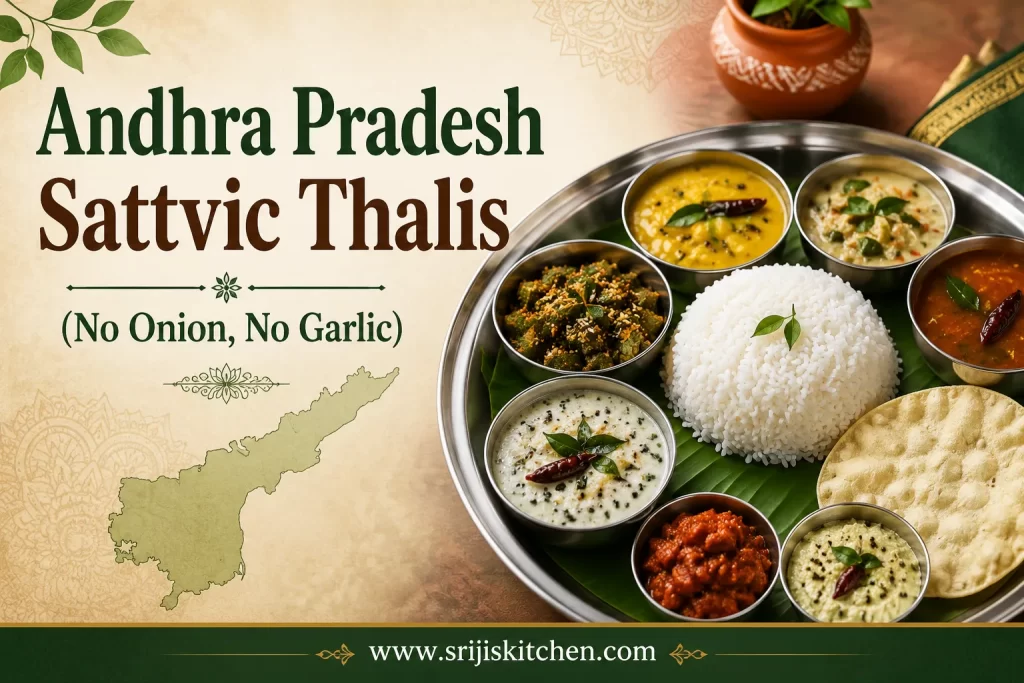
(Explore traditional Andhra Pradesh sattvic thalis featuring authentic Telugu meal combinations, prepared without onion and garlic and suitable for offering as naivedyam.)
Andhra Pradesh has one of India’s most distinctive regional food traditions, known for its rice-based meals, flavourful pappu, vegetable curries and vepudu, tangy pulusu, fresh pachadis, charu, pickles and traditional sweets. A complete Andhra bhojanam, or Telugu meal, brings several of these dishes together in combinations that vary according to region, season, occasion and family tradition.
The Andhra Pradesh sattvic thalis in this collection celebrate these traditional meal combinations while following Śrī Vaiṣṇava dietary principles. Every thali is prepared without onion and garlic and is designed to be suitable for offering as Naivedyam before being served as prasādam.
Andhra cuisine cannot be represented by a single thali. The food traditions of Coastal Andhra, Rayalaseema and Uttarandhra each contribute distinctive dishes and combinations, while everyday family meals can differ considerably from festive and special-occasion bhojanam. This collection will therefore feature multiple Andhra thalis, each highlighting a different aspect of the state’s rich culinary heritage.
Indian Sattvic Thalis · Andhra Recipes · No Onion No Garlic Recipes · Naivedyam
Andhra bhojanam and the traditional Telugu meal
A traditional Andhra bhojanam is built around rice accompanied by a variety of dishes that complement one another in flavour, texture and consistency. Pappu provides a comforting dal course, while kura or vepudu brings seasonal vegetables to the meal. Pulusu adds a distinctive tangy element, pachadi provides concentrated flavour, and charu offers a lighter accompaniment to rice.
Curd or perugu traditionally brings the meal towards a gentle close, while pickles, appadam and other accompaniments may be served alongside the main dishes. On festivals and special occasions, the meal may be expanded with preparations such as pulihora, garelu, payasam and other traditional sweets and savouries.
There is no fixed combination that every Andhra meal must follow. Everyday Telugu bhojanam may be quite simple, while festive meals can contain many more dishes. Seasonal produce, local traditions and family preferences all influence what appears on the plate.
Rice Recipes · Dal Recipes · Vegetable Curry Recipes · Rasam Recipes · Chutney Recipes · Sweet Recipes
Regional diversity of Andhra Pradesh thalis
Andhra Pradesh has several distinct culinary regions, and their traditional meals reflect differences in climate, agriculture, locally available ingredients and long-established food traditions. Coastal Andhra, Rayalaseema and Uttarandhra each have their own characteristic dishes and combinations, making it difficult for any single thali to represent the cuisine of the entire state.
The thalis in this collection will therefore explore these regional traditions individually, while adapting each meal to the sattvic principles followed at SriJi’s Kitchen.
Coastal Andhra thalis
The fertile coastal districts are known for rice-centred meals accompanied by pappu, vegetable curries, pulusu, pachadis, charu and curd. Seasonal vegetables, lentils, tamarind and traditional spice combinations create meals that can range from simple everyday bhojanam to elaborate festive spreads.
Coastal Andhra Thalis · Andhra Pappu Recipes · Andhra Pachadi Recipes
Rayalaseema thalis
Rayalaseema has a distinctive food tradition shaped by its drier climate and local crops. Traditional meals may feature rice alongside robust vegetable preparations, pappu, pulusu, chutneys and other regional dishes, with combinations that differ noticeably from those found in the coastal districts.
Rayalaseema Thalis · Rayalaseema Recipes · Andhra Vegetable Recipes
Uttarandhra thalis
Uttarandhra, or North Coastal Andhra, has its own regional cooking traditions across districts such as Srikakulam, Vizianagaram and Visakhapatnam. Rice remains central to many meals, accompanied by distinctive vegetable preparations, dals, pulusu, pachadis and other dishes shaped by local ingredients and family traditions.
Uttarandhra Thalis · Uttarandhra Recipes · Andhra Sattvic Recipes
Explore the regional traditions behind Coastal Andhra Thalis, Rayalaseema Thalis, and Uttarandhra Thalis to discover how Andhra bhojanam changes across the state.
Explore Andhra Pradesh sattvic thalis
The best way to experience Andhra cuisine is through complete meal combinations in which individual dishes are chosen to complement one another. This collection brings together Andhra Pradesh sattvic thalis inspired by traditional home cooking, regional favourites, seasonal ingredients and festive food traditions.
Each thali has its own page showing the complete meal and the dishes that make it distinctive. Individual dishes will also link to their own recipes, making it easy to prepare the complete thali or choose a few recipes to create a simpler Andhra bhojanam at home.
As the collection develops, you will find thalis from Coastal Andhra, Rayalaseema and Uttarandhra, together with everyday family meals and more elaborate festive combinations.
Everyday Andhra sattvic thalis
These thalis are inspired by the kinds of balanced meal combinations that can be prepared for an everyday Telugu bhojanam. They bring together rice, pappu, seasonal vegetables and traditional accompaniments in practical combinations suitable for family meals and naivedyam.
Bendakaya vepudu and tomato pappu Andhra thali
A traditional Andhra meal combining tomato pappu, bendakaya vepudu, rice and complementary accompaniments.
Vankaya kura and kandi pappu Andhra thali
A comforting Telugu bhojanam centred on rice, traditional pappu and a flavourful brinjal curry.
Dosakaya pappu Andhra thali
A homestyle Andhra meal featuring dosakaya pappu, seasonal vegetables and traditional accompaniments.
Palakura pappu Andhra thali
A simple everyday combination of rice, palakura pappu, vegetable preparations and traditional sides.
Explore our Everyday Andhra Thalis and individual Andhra Recipes to prepare complete Telugu meals or combine your favourite dishes to create your own sattvic Andhra bhojanam.
Festive Andhra sattvic thalis
Festivals, religious observances and family celebrations often call for a more elaborate Andhra bhojanam. Alongside rice, pappu and vegetable preparations, these meals may include special rice dishes such as pulihora, garelu, payasam, traditional sweets, pachadis, appadam and other dishes chosen according to the occasion and family tradition.
The festive thalis in this collection will bring these dishes together as complete sattvic meals while recognising that Andhra festive food varies considerably between regions, festivals and households. Rather than presenting one fixed festive thali, we will explore several traditional combinations suitable for different occasions.
Pulihora Andhra thali
A traditional Andhra meal centred on tangy, spiced pulihora with complementary vegetable dishes and accompaniments.
Dadhyojanam Andhra thali
A sattvic Telugu meal featuring traditional dadhyojanam with vegetable preparations and simple accompaniments.
Pongal Andhra thali
A comforting Andhra-style meal built around traditional pongal with suitable vegetable dishes and accompaniments.
Lemon rice Andhra thali
A bright, traditional meal centred on lemon rice with complementary sattvic dishes and accompaniments.
These festive combinations provide a starting point for planning a more elaborate Telugu meal. Explore Andhra Festival Recipes, Andhra Sweet Recipes, Pulihora Recipes, and Naivedyam Recipes to add traditional dishes and accompaniments according to the occasion.
Whether you are preparing a simple everyday bhojanam or a more elaborate festive spread, these Andhra Pradesh sattvic thalis bring together traditional dishes in balanced meal combinations that can be adapted to the season, occasion and dishes available.
Dishes that make up an Andhra thali
An Andhra thali brings together several individual preparations, each contributing a different flavour, texture or role to the meal. Rice usually forms the foundation, accompanied by dishes such as pappu, kura or vepudu, pulusu, pachadi and charu. Appadam, pickles, curd and traditional sweets may complete the bhojanam depending on the occasion.
Many of these dishes appear in more than one thali. Rather than repeating the same recipe, each dish in this collection has its own recipe page and can be combined with different meals. This makes it easy to prepare a complete traditional thali or select individual dishes for a simpler everyday Andhra bhojanam.
Rice and rice dishes
Rice is at the heart of most traditional Andhra meals. Plain steamed rice is commonly served with pappu, pulusu, charu, vegetable preparations and curd, while seasoned rice dishes may take a more prominent place during festivals, religious observances and special occasions.
Traditional preparations such as pulihora, nimmakaya annam and dadhyojanam can form part of a larger thali or be combined with a few complementary dishes to create a simpler meal. The choice of rice preparation often helps define the character of the complete bhojanam.
Explore Steamed Rice, Pulihora, Nimmakaya Annam, Dadhyojanam, and other Andhra Rice Recipes used across our Andhra thalis.
Pappu and dal dishes
Pappu is one of the defining elements of traditional Andhra home cooking. Lentils are combined with vegetables, leafy greens or tangy ingredients to create comforting dishes that are typically served with hot rice and ghee as part of an everyday bhojanam.
Popular combinations include tomato pappu, palakura pappu and dosakaya pappu, alongside simpler preparations based primarily on kandi pappu. Different pappu dishes can be paired with vepudu, kura, pachadi and other accompaniments to create a wide variety of Andhra thalis.
Explore Tomato Pappu, Palakura Pappu, Dosakaya Pappu, Kandi Pappu, and other Andhra Pappu Recipes for traditional dal dishes to include in your Andhra bhojanam.
Kura and vepudu
Vegetable dishes bring colour, texture and seasonal variety to an Andhra bhojanam. Kura includes a wide range of cooked vegetable preparations, while vepudu generally refers to drier stir-fried dishes that pair especially well with rice and pappu.
Vegetables such as bendakaya, vankaya, dondakaya, beerakaya, aratikaya and beans can be prepared in numerous traditional ways using different spice combinations. These dishes make it possible to vary an Andhra thali throughout the year while retaining the familiar structure of a Telugu home meal.
Explore Bendakaya Vepudu, Vankaya Kura, Dondakaya Vepudu, Aratikaya Vepudu, and other Andhra Vegetable Recipes to add seasonal vegetable dishes to your thali.
Pulusu and charu
Pulusu and charu add lighter, more fluid elements to an Andhra bhojanam and are traditionally enjoyed with rice. Pulusu is generally characterised by its tangy flavour and may include vegetables, while charu is a thinner, seasoned preparation related to the broader South Indian rasam tradition.
These dishes complement pappu, kura and vepudu particularly well, helping create contrast within the meal. Ingredients and seasoning vary considerably between households and regions, giving Andhra cuisine a wide range of traditional pulusu and charu preparations.
Explore Majjiga Pulusu, Mukkala Pulusu, Andhra Charu, and other Andhra Pulusu Recipes and Rasam Recipes to complete a traditional Telugu bhojanam.
Pachadi and accompaniments
Pachadi and other accompaniments add concentrated flavour and variety to an Andhra bhojanam. Traditional pachadis may be prepared with vegetables, leafy greens, sesame seeds, coconut or other regional ingredients, with their character varying according to season and local tradition.
Appadam, pickles and podis may also accompany the meal in smaller quantities. These elements are not necessarily present in every thali, but they can provide an important contrast to rice, pappu, kura, pulusu and other dishes.
Explore Andhra Pachadi Recipes, Andhra Pickle Recipes, Podi Recipes, Appadam, and other traditional Andhra Accompaniments to complete your Telugu bhojanam.
Sweets and payasam
Traditional sweets add a celebratory finish to an Andhra bhojanam and are especially important during festivals, religious occasions and family celebrations. Payasam, laddu and other Telugu sweets may be prepared according to the occasion, season and family tradition.
A simple everyday thali does not necessarily include a sweet, while a festive meal may feature one or several sweet preparations. When prepared for naivedyam, these dishes can form an important part of the complete offering before the meal is served as prasādam.
Explore Payasam Recipes, Andhra Sweet Recipes, Laddu Recipes, and other Traditional Indian Sweets suitable for adding to festive Andhra thalis.
Browse Andhra Rice Recipes, Andhra Pappu Recipes, Andhra Vegetable Recipes, Andhra Pulusu Recipes, Andhra Pachadi Recipes, and Andhra Sweet Recipes to discover the individual dishes used throughout these thalis.
Creating a sattvic Andhra bhojanam
Traditional Andhra cuisine includes a vast range of dishes, and recipes can vary considerably between regions, communities and households. The thalis at SriJi’s Kitchen preserve the familiar structure and flavours of Andhra bhojanam while following Śrī Vaiṣṇava dietary principles and avoiding onion and garlic.
Rather than simply removing onion and garlic from recipes that depend on them for flavour, we select traditional ingredients, spice combinations and cooking methods that allow each dish to retain its distinctive Andhra character. Pappu, vegetables, tamarind, coconut, sesame, chillies, curry leaves and traditional spice blends provide many ways to create flavourful and satisfying meals naturally.
A sattvic Andhra thali can be simple or elaborate. What matters is choosing dishes that complement one another and preparing them fresh with care, particularly when the meal is intended for offering as naivedyam.
Explore Andhra Recipes and Sattvic Recipes to discover individual dishes and build your own traditional Telugu bhojanam.
Preparing Andhra thalis for naivedyam
For devotees, preparing an Andhra bhojanam can also be an act of devotion. Freshly prepared rice, pappu, vegetable dishes, pachadi, pulusu, sweets and other suitable preparations can be brought together as a complete meal and respectfully offered as Naivedyam before being served.
The Andhra thalis at SriJi’s Kitchen are created with this purpose in mind. The recipes follow Śrī Vaiṣṇava dietary principles and avoid onion and garlic, allowing everyday meals as well as more elaborate festive thalis to be prepared for offering.
The number of dishes is not what makes an offering meaningful. A simple meal of rice, pappu and a vegetable preparation can be offered with the same care and devotion as a larger festive bhojanam.
For guidance on preparing and offering food at home, see our Naivedyam guide.
Why Andhra Pradesh thalis?
Andhra Pradesh has a remarkably varied food tradition, with meal combinations shaped by region, season, local produce and family customs. A thali provides a natural way to experience this diversity because it brings several complementary dishes together as they would be enjoyed as part of a complete Andhra bhojanam.
Rather than presenting Andhra cuisine as a collection of isolated recipes, these thalis show how rice, pappu, kura, vepudu, pulusu, pachadi, charu and accompaniments work together on the same plate. They also allow us to explore the differences between everyday meals, festive bhojanam and the distinctive traditions of Coastal Andhra, Rayalaseema and Uttarandhra.
For SriJi’s Kitchen, this format also provides a practical way to build complete sattvic meals from individual Andhra Recipes, while keeping every preparation suitable for offering as Naivedyam.
Explore our Andhra Recipes and Indian Sattvic Thalis to discover individual dishes and traditional meal combinations from Andhra Pradesh and across India.
How to serve an Andhra thali
A traditional Andhra thali is generally served with rice as the centre of the meal and a selection of pappu, kura or vepudu, pulusu, pachadi, charu and accompaniments arranged around it. Appadam, pickle and a sweet may also be included, depending on the meal and occasion.
The dishes are enjoyed in combinations rather than as completely separate courses. Rice may first be mixed with pappu and ghee, followed by other preparations such as pulusu or charu, while vegetable dishes and pachadis are eaten alongside. Curd or perugu with rice commonly comes towards the end of the meal.
For a festive or more elaborate Telugu bhojanam, the meal may traditionally be served on a banana leaf, with the various preparations arranged before the rice is served. Individual family and regional traditions influence both the dishes included and the order in which they are enjoyed.
Choose from our Andhra Recipes to assemble and serve a complete traditional Andhra bhojanam.
Common mistakes to avoid
- Treating one thali as the definitive Andhra thali: Andhra food traditions vary across Coastal Andhra, Rayalaseema and Uttarandhra, as well as between households and occasions.
- Making the thali unnecessarily elaborate: An everyday Andhra bhojanam can be simple. More dishes do not automatically make the meal more traditional or better balanced.
- Including too many similar dishes: Choose preparations that complement one another rather than repeating the same vegetables, textures or dominant flavours across the thali.
- Assuming Andhra food must always be extremely spicy: Chilli is important in many Andhra dishes, but good Telugu cooking balances heat with sour, savoury, mild and sometimes sweet elements.
- Treating sattvic cooking as simply removing onion and garlic: Choose traditional ingredients, seasonings and cooking methods that produce a balanced dish that is naturally flavourful and recognisably Andhra.
- Ignoring seasonal and regional combinations: Vegetables, pachadis, pulusu and other preparations traditionally vary with local produce, season and regional food customs.
- Treating festive and everyday meals as the same: Festival bhojanam may include special rice dishes, sweets and additional preparations that would not normally appear in a simple everyday meal.
Use our Andhra Recipes and Andhra Pradesh sattvic thalis to choose dishes that complement one another naturally in a complete Telugu bhojanam.
Frequently asked questions about Andhra thalis
Traditional Andhra meals vary considerably by region, household, season and occasion. These answers cover some common questions about Andhra thalis, Telugu bhojanam and preparing sattvic Andhra meals at home.
Is there one traditional Andhra thali?
No. There is no single combination that can be considered the definitive Andhra thali. Coastal Andhra, Rayalaseema and Uttarandhra have their own food traditions, and meals also vary between households, seasons and occasions.
The thalis in this collection therefore represent different traditional meal combinations rather than presenting one fixed meal as the definitive Andhra thali.
What dishes are usually included in an Andhra thali?
An Andhra thali commonly includes rice with pappu, one or more vegetable preparations such as kura or vepudu, and dishes such as pulusu, pachadi or charu. Curd, appadam and pickles may be served as accompaniments.
The exact combination depends on the region, season and occasion. Festive thalis may also include pulihora or another seasoned rice preparation, garelu, payasam and traditional sweets, while an everyday meal is usually much simpler.
What is the difference between an Andhra thali and Telugu bhojanam?
Telugu bhojanam simply means a Telugu meal and can refer to anything from a simple everyday meal to an elaborate festive spread. Andhra thali is a convenient way of describing a complete Andhra meal in which several dishes are served together.
In practice, the terms may overlap when referring to a traditional Andhra meal. On SriJi’s Kitchen, we use Andhra thali mainly for complete meal combinations, while Andhra bhojanam or Telugu bhojanam describes the broader meal tradition.
Are Andhra thalis always very spicy?
No. Andhra cuisine is well known for its use of chillies, but not every dish or thali needs to be intensely hot. A traditional meal brings together dishes with different flavour profiles, including mild pappu, vegetable preparations, tangy pulusu, pachadi, charu, curd and sometimes sweets.
The level of chilli can also vary by dish, region and household. A well-balanced Andhra thali is about complementary flavours rather than simply making every preparation spicy.
Can Andhra thalis be prepared without onion and garlic?
Yes. Traditional Andhra thalis can be assembled using dishes that are naturally prepared without onion and garlic. Pappu, vegetable preparations, pulusu, pachadi, charu, rice dishes and sweets provide many possibilities for creating a complete and balanced meal.
The Andhra thalis at SriJi’s Kitchen follow Śrī Vaiṣṇava dietary principles, with each meal combination designed to be sattvic and suitable for offering as naivedyam.
How do Coastal Andhra, Rayalaseema and Uttarandhra thalis differ?
The three regions have distinctive food traditions shaped by local ingredients, climate, agriculture and long-established cooking practices. As a result, the types of pappu, vegetable preparations, pulusu, pachadis and other dishes served together can vary from one region to another.
Our Coastal Andhra thalis, Rayalaseema thalis and Uttarandhra thalis reflect these regional differences rather than treating Andhra cuisine as a single uniform meal tradition.
What is the difference between an everyday Andhra thali and a festive thali?
An everyday Andhra thali is generally simpler, bringing together rice with pappu, a vegetable preparation and a few suitable accompaniments. The combination varies according to the season, ingredients available and family tradition.
A festive thali is usually more elaborate and may include special rice preparations such as pulihora, additional vegetable dishes, garelu, payasam and other traditional sweets or savouries. The exact menu depends on the festival, occasion and household tradition.
Can I substitute dishes in an Andhra thali?
Yes. Andhra thalis naturally vary according to season, availability and family tradition, so individual dishes can be substituted while keeping the overall meal balanced and recognisably Andhra.
For example, one pappu or vegetable preparation can be replaced with another traditional Andhra dish that complements the rest of the meal. The thalis in this collection are intended as traditional meal combinations rather than rigid menus that must be followed exactly.
Are these Andhra thalis suitable for offering as naivedyam?
Yes. The Andhra thalis in this collection are prepared according to Śrī Vaiṣṇava dietary principles and without onion and garlic, making them suitable for offering as Naivedyam before serving.
The offering does not need to be an elaborate thali. A simple Andhra bhojanam prepared fresh with care and devotion can also be offered and then honoured as prasādam.
Do I need to prepare every dish shown in an Andhra thali?
No. The thalis in this collection can be used as complete meal plans or simply as inspiration for choosing dishes that work well together. You can prepare the entire thali or select a smaller combination according to the occasion, time available and number of people being served.
Even a simple meal of rice, pappu and a vegetable preparation can form a satisfying traditional Andhra bhojanam.
These answers provide a starting point for planning traditional Andhra thalis at home. Explore the thali combinations throughout this collection or choose individual Andhra Recipes to create an Andhra bhojanam suited to the season, occasion and dishes available.
Final thoughts
Andhra cuisine offers an extraordinary variety of meal combinations, from simple everyday bhojanam to elaborate festive spreads. By bringing pappu, vegetable preparations, pulusu, pachadi, charu, rice dishes and traditional accompaniments together, an Andhra thali allows these dishes to be enjoyed as part of a complete and balanced Telugu meal.
The Andhra Pradesh sattvic thalis at SriJi’s Kitchen celebrate this diversity through meals inspired by Coastal Andhra, Rayalaseema and Uttarandhra, while following Śrī Vaiṣṇava dietary principles. As the collection develops, new thalis and individual Andhra Recipes will provide many more ways to prepare traditional Telugu bhojanam without onion and garlic and suitable for offering as Naivedyam.
Explore Indian Sattvic Thalis · Andhra Recipes · Naivedyam
Explore sattvic thalis from other Indian states and Union Territories
Continue exploring India’s regional food traditions through our collection of Indian Sattvic Thalis from states and Union Territories. Each collection brings together traditional meal combinations prepared without onion or garlic and suitable for offering as naivedyam.
Return to Indian Sattvic Thalis to browse the complete collection of regional thalis from across India.